

Xylose Market Forecast 2036: USD 4.60 Billion Outlook as China Dominates Growth | Key Players DuPont, Stora Enso, ADM
Xylose Market
Global xylose market grows steadily, driven by natural sweeteners, biofuel demand, and strong China-led expansion in food and pharma sectors.
NEWARK, DE, UNITED STATES, March 31, 2026 /EINPresswire.com/ -- According to analysis by Future Market Insights (FMI), the global xylose market is witnessing steady and structured expansion, supported by its dual role across food ingredient processing and biorefinery value chains. The market’s evolution is increasingly influenced by the growing demand for natural sweeteners, advancements in biomass conversion technologies, and the rising integration of xylose in pharmaceutical and biofuel applications.
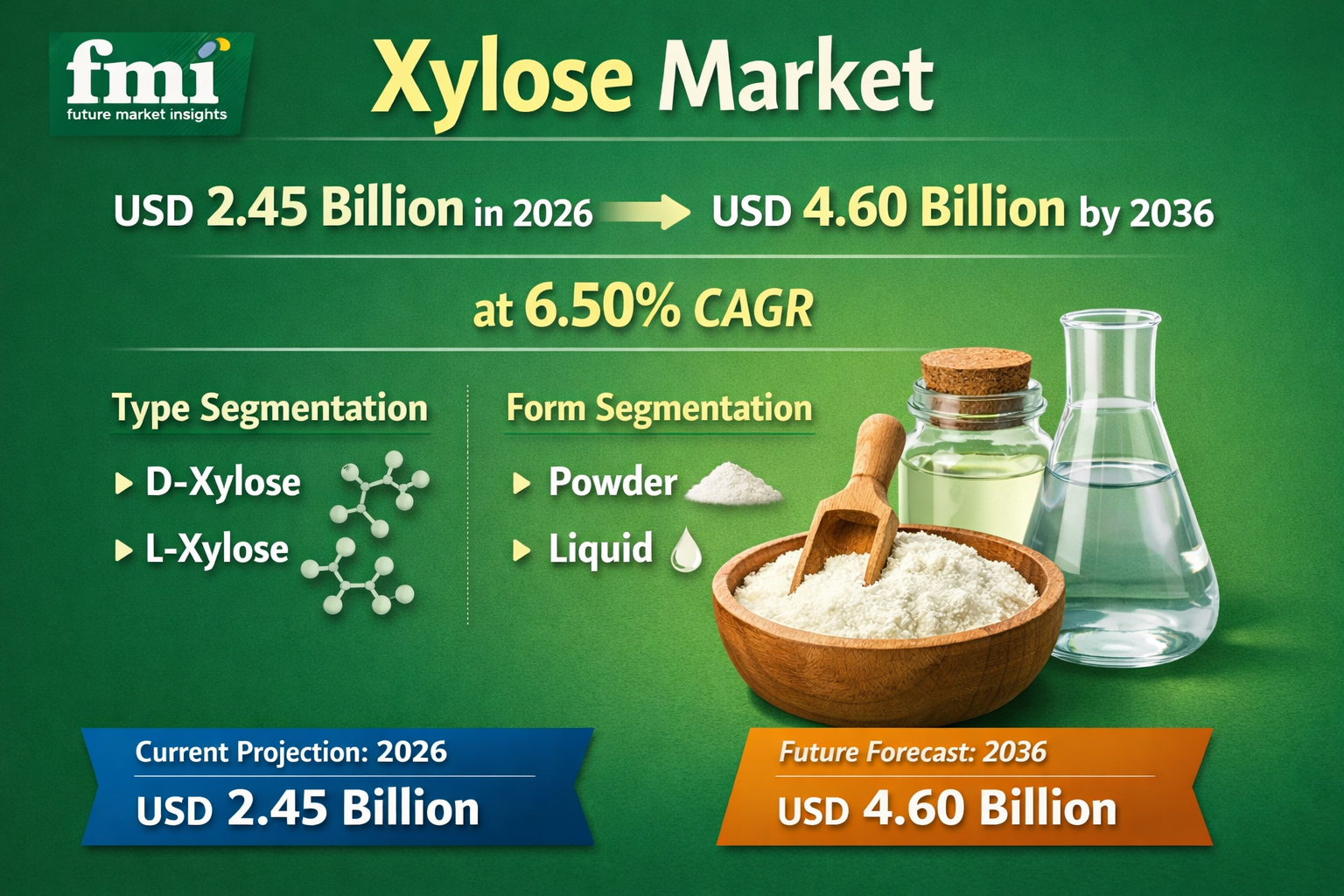
The xylose market was valued at USD 2.30 billion in 2025 and is projected to reach USD 2.45 billion in 2026. Over the forecast period, demand is expected to grow at a CAGR of 6.50%, ultimately reaching USD 4.60 billion by 2036.
This growth trajectory reflects stable volume expansion driven by food, pharmaceutical, and bioethanol demand, along with gradual improvements in production efficiency and cost competitiveness.
Get Access of Report Sample: https://www.futuremarketinsights.com/reports/sample/rep-gb-25658
Xylose Market Snapshot
• Market Value (2025): USD 2.30 Billion
• Forecast Value (2036): USD 4.60 Billion
• Forecast CAGR (2026–2036): 6.50%
• Leading Type Segment: D-Xylose (54.6% share)
• Top Form Segment: Powder (61.2% share)
• Leading End Use Industry: Food & Beverage (47.9% share)
• Fastest Growing Market: China
Food Ingredient Innovation and Xylitol Demand Drive Market Expansion
A primary factor shaping the xylose market is its critical role as a precursor in xylitol production and as a functional ingredient in food processing. D-xylose dominates the market due to its established use in Maillard reaction browning for baked goods and savory products, as well as its importance in producing low-calorie sweeteners.
Food and beverage manufacturers are increasingly incorporating xylose into clean-label formulations, replacing artificial additives and caramel colorants. This trend is aligned with rising consumer preference for natural, low-calorie, and functional ingredients, supporting strong demand growth across bakery, confectionery, and beverage applications.
Additionally, the expansion of bioethanol production and renewable energy initiatives is creating new avenues for xylose utilization as a fermentation substrate, reinforcing its importance in sustainable industrial ecosystems.
Powder Form Dominance Enhances Industrial Applicability
By form, powder-based xylose is projected to account for 61.2% of the market in 2026.
Its dominance is supported by:
• Superior handling and storage stability
• Precise dosing capabilities in industrial applications
• Compatibility with food and pharmaceutical formulations
Powdered xylose offers uniformity and ease of integration into manufacturing processes, making it the preferred choice among food ingredient blenders and pharmaceutical companies.
Pharmaceutical Applications Provide Stable High-Value Demand
The pharmaceutical industry represents the second-largest end-use segment, where xylose serves as:
• A diagnostic substrate in intestinal absorption testing
• A chiral intermediate in active pharmaceutical ingredient (API) synthesis
This segment provides consistent, high-value demand, supported by the increasing focus on diagnostic accuracy and the growing need for specialized intermediates in drug manufacturing.
Supply Chain Integration and Biorefinery Expansion Shape Market Dynamics
The xylose market is structurally linked to hemicellulose processing from agricultural biomass such as corncobs, birchwood, and sugarcane bagasse.
Producers with vertically integrated operations—covering extraction, purification, and downstream processing—benefit from:
• Cost efficiency
• Supply chain stability
• Greater control over product quality
However, the expansion of biorefinery capacities may increase supply availability, potentially leading to pricing pressure if demand from food and xylitol applications does not keep pace.
China Leads Growth with Strong Industrial Base
Regionally, the xylose market is witnessing the fastest growth in China, projected at a CAGR of 8.8% from 2026 to 2036.
Xylose Market Growth by Country (2026–2036):
• China: 8.8%
• India: 8.1%
• Germany: 7.5%
• France: 6.8%
• United Kingdom: 6.2%
• United States: 5.5%
• Brazil: 4.9%
China’s leadership is driven by:
• High concentration of hemicellulose processing facilities
• Expansion of xylitol manufacturing capacity
• Strong availability of agricultural feedstock
India follows with robust growth supported by increasing health awareness, rising demand for sugar alternatives, and government-backed bioethanol initiatives.
Clean-Label Trends and Biofuel Demand Unlock Opportunities
The xylose market is benefiting from multiple growth drivers, including:
• Rising demand for natural sweeteners in food and beverages
• Expansion of bioethanol and renewable energy sectors
• Increasing applications in pharmaceuticals and nutraceuticals
• Growing consumer preference for clean-label and low-calorie products
Technological advancements in biomass processing and sustainable extraction methods are further enhancing production efficiency and scalability.
Competitive Landscape
The xylose market is moderately consolidated, with competition driven by production capacity, product purity, and supply chain integration.
Key companies include:
• DuPont
• Shandong Longlive Bio-Technology
• Zhejiang Huakang Pharmaceutical
• Hebei Huaxu Pharmaceutical
• Archer Daniels Midland
• Stora Enso
• Futaste Co., Ltd.
• Shandong Xieli Bio-tech Co., Ltd.
• Jilin Yuxin Biotechnology Co., Ltd.
These players are focusing on vertical integration, technological advancements, and global distribution expansion to strengthen their market position.
Market Outlook: Steady Growth Anchored in Food and Biorefinery Applications
The long-term outlook for the xylose market remains positive, driven by its essential role in natural sweetener production, food processing, and renewable energy applications.
However, the market will remain sensitive to:
• Agricultural feedstock price fluctuations
• Capacity expansion in biorefineries
• Demand-supply balance in xylitol and food sectors
As the market evolves, companies that invest in integrated production systems, application-specific product development, and diversified supply chains will be best positioned to capture emerging opportunities and sustain growth.
Browse More Reports from Food and Beverages:
High-Intensity Sweetener Market: https://www.futuremarketinsights.com/reports/high-intensity-sweetener-market
Marine Enzymes Market: https://www.futuremarketinsights.com/reports/marine-enzymes-market
Protein Hydrolysate Ingredient Market: https://www.futuremarketinsights.com/reports/protein-hydrolysate-ingredient-market
Calcium Propionate Market: https://www.futuremarketinsights.com/reports/calcium-propionate-market
Sudip Saha
Future Market Insights Inc.
+18455795705 ext.
email us here
Legal Disclaimer:
EIN Presswire provides this news content "as is" without warranty of any kind. We do not accept any responsibility or liability for the accuracy, content, images, videos, licenses, completeness, legality, or reliability of the information contained in this article. If you have any complaints or copyright issues related to this article, kindly contact the author above.
