
Global Paraffin Wax Market Outlook: Asia-Pacific Leads Packaging & Candle Demand with ExxonMobil, Shell & Sasol
Paraffin Wax Market
Paraffin wax is a petroleum-derived hydrocarbon wax produced by refining slack wax from lubricant production. It is mainly used in candle manufacturing, food
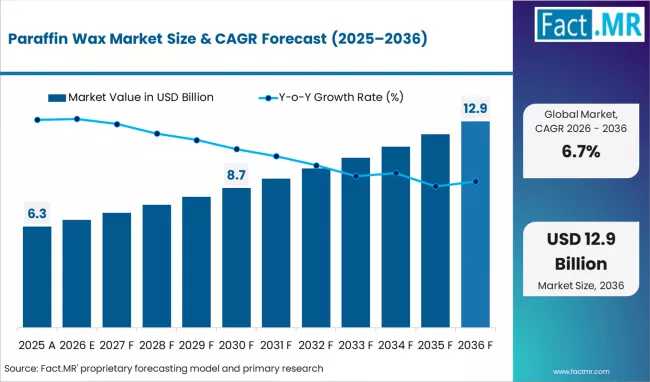
ROCKVILLE, MD, UNITED STATES, April 8, 2026 /EINPresswire.com/ -- According to Fact MR, latest analysis, the global paraffin wax market is witnessing a structural transformation driven by application diversification and premium-grade demand. The market is valued at USD 6.30 billion in 2025, projected to reach USD 6.72 billion in 2026, and forecast to expand to USD 12.86 billion by 2036, registering a CAGR of 6.7%.The market is expected to create an incremental opportunity of USD 6.14 billion over the forecast period. This growth is fueled by increasing demand in food packaging coatings, premium home fragrance candles, and cosmetic-grade formulations. A key transformation trend is the shift from commodity-grade wax toward fully refined, high-purity specialty waxes, which command higher margins and long-term contracts.
Get detailed market forecasts, competitive benchmarking, and pricing trends: https://www.factmr.com/connectus/sample?flag=S&rep_id=12179
Quick Stats
Market Size (2025): USD 6.30 Billion
Market Size (2026): USD 6.72 Billion
Forecast Value (2036): USD 12.86 Billion
CAGR (2026–2036): 6.7%
Incremental Opportunity: USD 6.14 Billion
Leading Segment: Packaging (33%+ share)
Leading Region: Asia-Pacific (India & China)
Key Players: Sinopec, PetroChina, Sasol, ExxonMobil, Repsol
Executive Insight for Decision Makers
The paraffin wax market is shifting from volume-driven commodity sales to specification-driven procurement.
Refiners must invest in de-oiling and percolation capacity to produce fully refined grades
Packaging converters should secure food-grade certified suppliers to meet regulatory demands
Investors should focus on companies with vertical integration and specialty wax capabilities
Risk of Inaction:
Companies relying on semi-refined wax risk being locked into low-margin segments and excluded from high-growth packaging and cosmetic applications.
Market Dynamics
Key Growth Drivers
Expansion of food packaging industry and moisture barrier requirements
Rising demand for premium home fragrance and decorative candles
Growth in cosmetics and personal care formulations using pharmaceutical-grade wax
Increasing use in hot melt adhesives and industrial applications
Key Restraints
Environmental concerns around petroleum-derived products
Crude oil price volatility impacting feedstock costs
Competition from bio-based and synthetic wax alternatives
Emerging Trends
Shift toward fully refined, low-oil-content wax
Development of specialty blends with customized melting points
Rising adoption of sustainable and bio-blended wax solutions
Increasing focus on food-contact certification and regulatory compliance
Segment Analysis
Leading Segment: Packaging (33.1% share) due to strong moisture barrier properties
Fastest Growing Segment: Cosmetics & personal care driven by premium formulations
Application Breakdown
Packaging (food coatings, corrugated boxes)
Candles (decorative, aromatic, religious) – ~31% share
Cosmetics & hot melts (~16–17%)
Strategic Importance:
Packaging remains critical due to regulatory compliance and recyclability trends, while cosmetics drive high-margin growth opportunities.
Supply Chain Analysis (Critical Insight)
Value Chain Structure:
Raw Material Suppliers
Crude oil producers → Slack wax (by-product of lubricant refining)
Manufacturers / Refiners
Petrochemical companies refine slack wax into paraffin wax
Fully refined vs semi-refined differentiation defines margins
Distributors & Blenders
Specialty chemical distributors supply to regional industries
Blending companies customize formulations for specific applications
End-Users
Packaging converters (food coatings, paperboard)
Candle manufacturers (retail & religious use)
Cosmetic companies (skincare, emollients)
Adhesive manufacturers
Who Supplies Whom
Refiners → Packaging & cosmetic manufacturers (premium contracts)
Distributors → SMEs & regional candle producers
Blenders → Specialty application industries
Insight:
Supplier qualification cycles (6–18 months) create high switching costs, favoring established players.
Pricing Trends
Commodity vs Premium Pricing:
Semi-refined wax = price-sensitive, commodity-driven
Fully refined wax = premium pricing, stable margins
Key Influencing Factors
Crude oil prices
Refining complexity and purity levels
Regulatory certifications (food, cosmetic)
Demand from high-margin industries
Margin Insight:
Premium grades maintain margin stability independent of crude volatility.
Regional Analysis
Top Countries by CAGR (2026–2036)
India: ~7.8% (fastest growth – packaging + cultural demand)
China: ~7.4% (refining capacity + industrial demand)
South Korea: ~6.3% (cosmetics growth)
USA: ~5.9% (premium candles + cosmetics)
Germany: ~5.6% (high-quality manufacturing)
Regional Insights
Asia-Pacific: Dominates growth due to manufacturing expansion
North America & Europe: Mature markets with premium demand
Emerging Markets: Driven by affordability and packaging demand
Competitive Landscape
Market Structure: Moderately consolidated
~50–70 active global and regional players
Key Companies
China Petrochemical Corporation (Sinopec)
PetroChina Company Limited
Sasol Limited
Exxon Mobil Corporation
Repsol
Petrobras
NIPPON SEIRO CO., LTD.
H&R Group
Honeywell International Inc.
Competitive Strategies
Refining scale and feedstock access
Specialty product innovation
Strong distribution networks
Technical support and certifications
Strategic Takeaways
For Manufacturers
Invest in fully refined wax production capacity
Focus on certification and specialty applications
For Investors
Target companies with vertical integration and premium product mix
For Marketers / Distributors
Position products around application-specific benefits
Highlight compliance and performance advantages
Future Outlook
The paraffin wax market is transitioning toward a specialty materials ecosystem, where purity, performance, and compliance drive value.
Increasing role of cosmetics and packaging sectors
Integration of bio-based blends and sustainability solutions
Growth in AI-driven formulation and product customization
Conclusion
The global paraffin wax market is no longer a simple refinery by-product industry—it is evolving into a high-value, application-driven materials market.
Companies that align with premium-grade production, regulatory compliance, and supply chain integration will capture the majority of future growth opportunities.
Why This Market Matters
Paraffin wax sits at the intersection of energy, packaging, consumer goods, and personal care industries. Its evolution reflects broader shifts toward sustainability, premiumization, and application-specific material science, making it a critical market for long-term strategic investment.
Unlock 360° insights for strategic decision making and investment planning https://www.factmr.com/checkout/12179
Related Reports:
Isoparaffin Solvent Market https://www.factmr.com/report/isoparaffin-solvent-market
C5-C8 Normal Paraffin Market https://www.factmr.com/report/c5-c8-normal-paraffin-market
Wax Additive Market https://www.factmr.com/report/wax-additive-market
Wax Dispersion Market https://www.factmr.com/report/wax-dispersion-market
S. N. Jha
Fact.MR
+1 628-251-1583
email us here
Legal Disclaimer:
EIN Presswire provides this news content "as is" without warranty of any kind. We do not accept any responsibility or liability for the accuracy, content, images, videos, licenses, completeness, legality, or reliability of the information contained in this article. If you have any complaints or copyright issues related to this article, kindly contact the author above.
